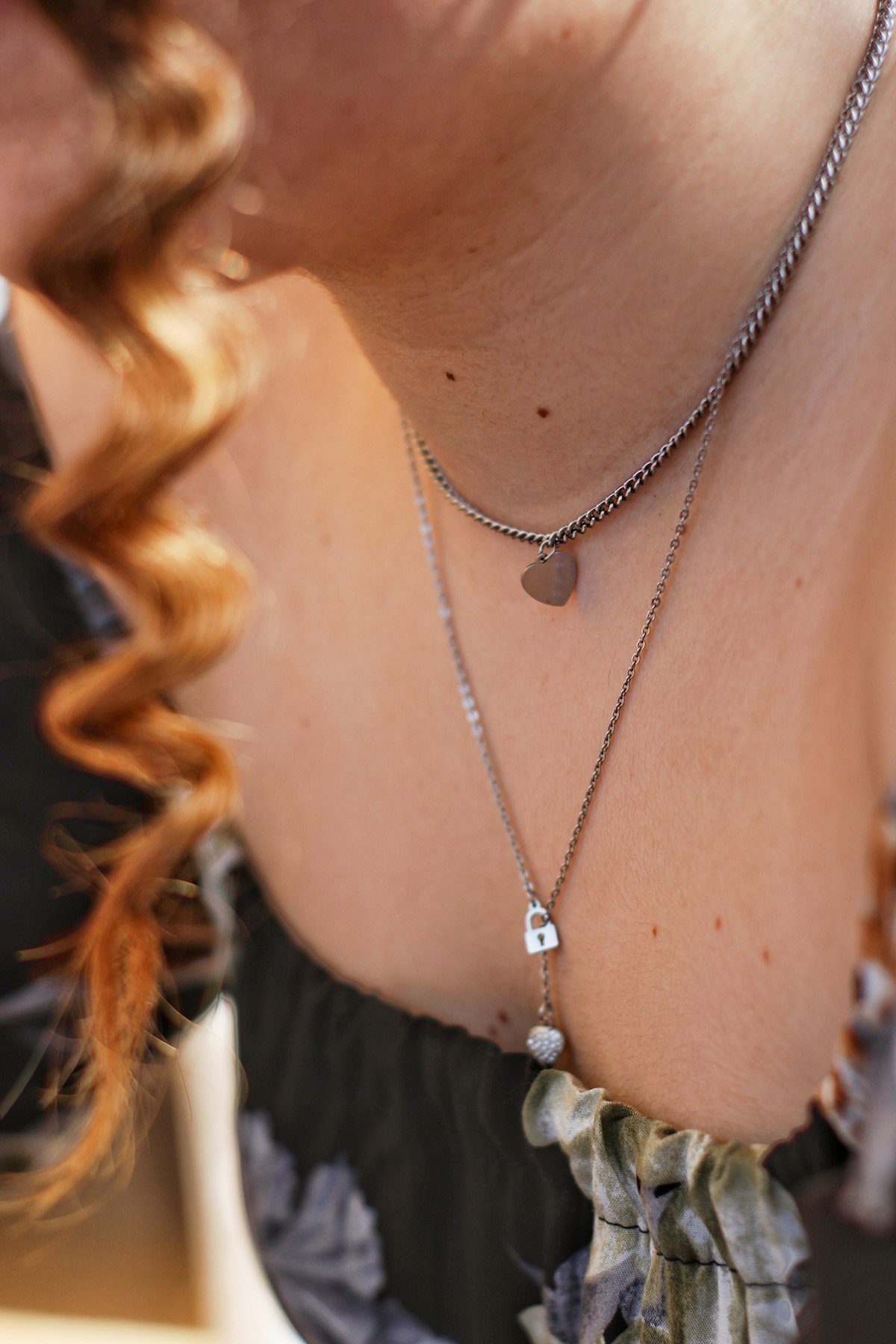
Compare a small necklace group through its visible lengths and spacing, choosing through your own neckline while keeping each piece’s handling requirements clear.
A layered necklace group is easier to judge when you can see what each length contributes. Start with the neckline you intend to wear, add one piece at a time and compare the spaces between them. You may prefer a close group, a wider separation or a single necklace. The point is a readable personal choice, not a requirement to use every piece that belongs to a matching collection.
Begin with the necklace you want to keep
Choose the piece that matters most to the outfit. It might be a pendant you enjoy or a quieter chain that suits the neckline. Wear it through the garment's ordinary arrangement and notice where it rests. Do not start by adding several pieces and then trying to identify which one made the group feel crowded.
The necklace and plain-top guide helps with this first relationship. A necklace can sit against fabric or within an open neckline; the actual top determines what remains visible.
Add the next length as a separate decision
Put on another piece only through its appropriate handling and fastening. Look at the visible gap between the chains and pendants. If two elements repeatedly occupy the same place, ask whether you enjoy that closeness or wanted them to read separately. The answer is visual and personal, not a judgement that one spacing is always correct.
Try the group from an ordinary mirror distance as well as close up. A small pendant may be distinct nearby but disappear into a larger one across the room. A longer chain may supply a quieter line instead of another focal point. Keep the role you actually see rather than the one implied by a product photograph.
Compare the group with the next layer
Add the cardigan or jacket you expect to wear and notice which parts remain visible through its opening. A group that looks clear against a plain top can become more complicated beside a lapel, button line or scarf. Remove one element before assuming another accessory will restore balance.
For an evening outfit, the satin slip-dress layering guide considers the garment group as a whole. Jewellery is one part of that arrangement and does not need to compete with every visible edge.
Notice ordinary movement and handling
Move normally and check whether the pieces remain comfortable and manageable together. Do not infer compatibility or care from appearance alone. Keep each item's own handling requirements clear, and leave a combination out when an important question about use remains unresolved.
If the pieces cross or gather in a way you dislike, try a simpler group rather than an increasingly elaborate adjustment. A single necklace can preserve the element you wanted without making the rest of the day about arranging several chains.
Record the preferred combination briefly if you expect to pack it again. Identify the pieces and the top, since the neckline was part of the decision. Then put the unused options back in their appropriate places. A useful necklace group gives each chosen length a purpose and leaves the outfit easier to wear, not merely fuller.
Editorial note
Practical style and travel guidance. Follow the relevant maker’s instructions and check current arrangements with your provider. Availability and policies can change. Our outfit and packing suggestions are editorial guidance, not claims of hands-on testing.